
Community
Tungsten Carbide Rods
-
Introduction of carbide rods
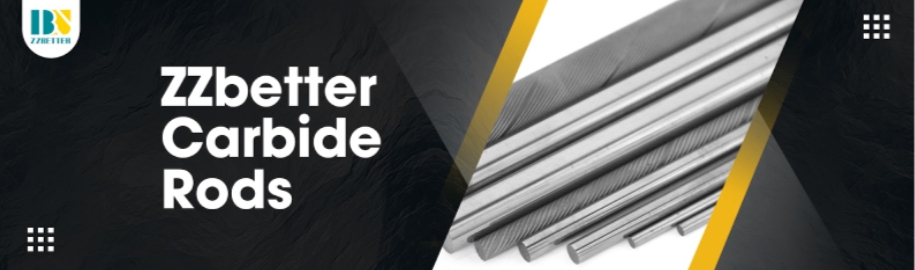
Tungsten carbide rods also called carbide round bars, cemented carbide rods, are a high-hardness, high-strength, and high-hardness material. It has a major raw material of WC, with other metals and pastes phases using powder metallurgical methods through low-pressure sintering.
-
How to produce tungsten carbide round bar?
The main process flow includes powder milling formula according to application requirements → wet milling → mixing → crushing → drying → sieving → adding forming agent → re-drying → sieving to obtain a mixture → granulating → pressing → forming → low-pressure sintering → forming (blank) → cylindrical grinding and fine grinding (the carbide blank does not have this process) → detecting and testing → packaging.
-
Application of cemented carbide rods
Cemented carbide round bars have a series of excellent properties such as high hardness, high wear resistance, high strength, bending resistance, and long work life.
There are different types of the tungsten carbide rods, such as solid carbide rods, carbide rods with one straight hole, carbide rods with two straight holes, carbide rods with two helix coolant holes, carbide rods with two three coolant holes, solid carbide tapered rods, other special shapes. Different types and different grades cemented carbide rods are used for different applications.
-
Carbide rods for making cutting tools
The main application of the carbide rods is for making cutting tools. such as the drills, automotive cutting tools, printed circuit board cutting tools, engine cutting tools, integral end mills, dental burs, integral reamers, engraving knives, etc. Cemented carbide rods for making cutting tools, the popular grades are always content 6% Cobalt to 12% Cobalt. For making end mills, choose solid carbide rods, also named carbide rods without the hole. For making drills, the carbide rods with coolant holes are a good choice.
-
Carbide rods for making punches
Tungsten carbide round bars can be used for making punches too. Those carbide rods are with cobalt from 15% to 25%. The punches also called tungsten carbide punch dies. Tungsten Carbide Punches and Dies are “made better to last longer” as compared to steel punches and die with less maintenance downtime. There are different shapes, such as carbide punches with key grooves, carbide punches with taps, carbide straight punches, key flat shank carbide punches. Solid carbide punch is one of forming tools, is used for producing various specific parts.
-
Carbide rods for making mandrels
Carbide rods for making mandrels are used to draw tubes and to determine the internal diameter of the pipe. The mandrel is fixed on a (mandrel) bar. The mandrel is inserted with the mandrel bar into the drawing die and the drawing material is formed between the drawing die and mandrel. Fixed mandrels are used in sizes ranging from 2.5 to 200 mm pipe diameter. The suitable carbide grade and the high-quality mirror surface finish within the smallest tolerances ensure the maximum service life of the mandrels. These tools can be provided with a surface coating to provide maximum lifetime.
-
Carbide rods for making tools holders
When you need an anti-vibration tool holder, we will recommend the carbide rods with 15% Cobalt. Usually, the carbide rods for making tool holders are with big diameters, such as 25 mm, 30 mm.
-
Carbide rods for making plunger
Carbide rods are used for making high-pressure plungers, they are good to wear-resistant and have a high polished finish. They can work well when they are in extreme pressure pumping of various fluids and gasses. They can increase the pump’s internal life cycle. The popular sizes are D22*277 mm, D26*277 mm, D33*270 mm, D17*230 mm.
-
Carbide rods for making piercing tools
Do you know how to make the holes of the cloth buttons? Most buttons factories use carbide rods.
They will sharpen the tips of the carbide rods and install them on the machine. The diameter of the carbide rods always is 1.2 mm, 1.4 mm, 1.5 mm, 1.6 mm, 1.8 mm, and so on. The length of the carbide needles is 80 mm,90mm, 100 mm, 330 mm. According to different materials of the buttons, such as seashell buttons, plastic buttons, there are different grades of the carbide rods for them.
-
Common questions about carbide rods
Q1: What is the difference between cemented and tungsten carbide?
Cemented carbides consist of hard grains of the carbides of transition metals (Ti, V, Cr, Zr, Mo, Nb, Hf, Ta, and/or W) cemented or bound together by a softer metallic binder consisting of Co, Ni, and/or Fe (or alloys of these metals). Tungsten carbide (WC), on the other hand, is a compound of W and C. Since most of the commercially important cemented carbides are based on WC as the hard phase, the terms “cemented carbide” and “tungsten carbide” are often used interchangeably.
Q2: What is the value of tungsten carbide rods?
Tungsten carbide rod is the preferred material for metal cutting tool manufacturing, widely used in industries that have high requirements for wear resistance, corrosion resistance, and high-temperature resistance. It has a lot of outstanding performance.
Q3: What are the uses of tungsten carbide rods?
Carbide rods can be used not only for cutting and drilling tools (such as micron, twist drills, and drill vertical mining tool specifications) but also for input needles, various roll-worn parts, and structural materials. In addition, it can be used in many fields, such as machinery, chemical, petroleum, metallurgy, electronics, and defense industries.
Q5: What are the Categories Of Tungsten Carbide Rod?
1.From the shape, It can divide into non-hoke tungsten carbide rods, straight holes tungsten carbide rods (including one, two, or three holes), 30 degrees, 40 degrees, or twisted spiral straight line tungsten carbide rods.
- According to the structure, a tungsten carbide rod can be classified into a PCB tool, a solid tungsten carbide bar, a single straight-hole bar, a double straight-hole bar, a two-spiral bar, a three-spiral bar, and other types.
- According to the shaping process, carbide rods can be classified into two types extrusion molding and compression molding.
-
Why chose ZZBETTER tungsten carbide rods?
We are experienced in tungsten carbide tools production and management. Our company gathered the professional staff members in the area of designing, producing and sales. We produce various grades of tungsten carbide rods and carbide rod blanks. Here we list some reasons for you to choose us.
A. Powder Excellent.
We use the 100% virgin material powder for carbide rods for all our standard grades for carbide rod manufacturing.
B. Advanced production equipment
- Spray tower
- HIP Sintering
The advanced computer-controlled HIP furnaces from Germany are applied to provide more pressure during the sintering process in order to get a denser structure.
C. Hardness test of tungsten carbide
The hardness detection of tungsten carbide mainly uses a Vickers hardness tester to test HRA hardness values. The test has a strong shape and dimensional adaptability of the test piece with high efficiency.
D. Fast Production
Three different compaction methods, including extrusion, automatic press, and cold isostatic press, are used for the maximum efficiency of carbide rod manufacturing.
- Extrusion
- Automatic Press
- Dry-bag isostatic pressing
E. Professional team
Our company gathered professional staff members in the area of designing, producing, and marketing. Our workers are well trained and experienced. Our team is honest, positive, credible, and glad to provide solutions for customers and create value.
ZZBETTER has got GB/T19001-2016 / ISO9001:2015 certificate, with advanced equipment, test facilities, and professional employees. We strictly carry on ISO9001:2015 requirement to guarantee the quality.
If you are interested in tungsten carbide rods and want more information and details, you can CONTACT US by phone or mail at the left, or SEND US MAIL at the bottom of the page.