
Community
NASA Project: The Moon’s Railway System
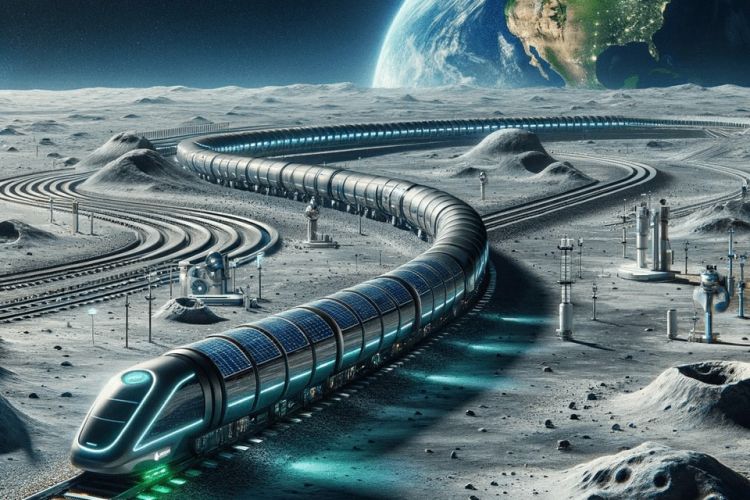
Among some of the crucial NASA decisions, is this novel moon project that is set to be funded on the proposal of one of its mechanical engineers. This ambitious venture called FLOAT (Flexible Levitation On A Track) was started in May and falls under NASA’s Innovative Advanced Concepts (NIAC). In total, money was disbursed by NASA to six separate groups within NIAC with a mandate of developing forward looking and diverse ideas. FLOAT stands out among many other projects since it has both a visionary simplicity as well as potential impact compared to other projects which include telescopes, pulsed rockets, quantum dot solar cells etc.
FLOAT: The Visionary Project
Ethan Schaler leads a team that plans to develop the first ever railway track on the moon; he works at JPL – NASA as a robotics engineer. Schaler sees FLOAT as an innovative system that can move materials across the moon ‘s surface like trains do on earth. However, this will have to wait until after 2030 when a permanent lunar base will have been built according to a roadmap defined by NASA and other space agencies.
People also read: Expatriates’ services
A Purpose and Possible Use of Lunar Rail Systems
To gain scientific knowledge, enhance technological advancement, utilize natural resources on the moon etc., there must be an establishment of a lunar base. There are huge amounts of minerals and elements not only on Earth but also on the Moon including helium 3. These can be integrated into advanced technology such as smartphones, computers among others. Also, the discovery of water ice in this celestial body is very useful because it can be converted into water or other things needed for human survival while living here.
For going to Mars: Launching from Here
Going by less gravitational pull compared to Earth plus lack of atmosphere makes launching from the moon more preferable than any other places on earth for going on Mars. The journey through space would become shorter in kilometres if we launched a rocket from the moon where there would be very little drag. Therefore, it will be necessary to move around with water and other resources such as liquid hydrogen through such trains as those proposed by FLOAT on the moon’s surface. The other option would be importing them from Earth, but this would not just make economic sense due to cost implications. Thus, it is advisable to source these directly from the lunar environment because of such reasons both in terms of logistically as well as economically.
Read about:Driving License Translation in Dubai
Overcoming Lunar Challenges
The traditional lunar vehicles are not as good as the FLOAT system for several reasons. Vehicles running on wheels face a problem since they cannot navigate the rough and dusty terrain of the moon easily. Moreover, dust can quickly build up in rover wheels causing vehicle blockage during motion hence making it immobile forever. On the contrary, a railway system offers a fixed path so that vehicles will not trap themselves in unstable conditions.
The FLOAT’s railway line will consist of several layers where the train floats above them on tracks through magnetic levitation instead of running over them. This choice for levitation reduces wearing out of the system which in turn increases lifespan. NASA, at first, gave its financial support to FLOAT’s phase 2 that focuses on aspects related to the environment like exposure to radiation and temperature extremes on the moon. By conducting feasibility studies as a result of simulations made using small-scale models of lunar environments; scientists can decide if they can implement it in the future.
If the FLOAT project is successful, it may pave the way for constructing not only a moon base but also other bases on other planets. As imaginary as it might appear with today’s technological and human progressions, one day there could be moon railways. Scientists are planning to build a train which can run 1 mile per hour and can transport 100 tons of material across the moon to build the base. This system will enable scientists to develop lunar infrastructure with the convenience of transporting material from the moon’s own resources.
In conclusion, the development of a railway system on the moon is not just a futuristic concept but a tangible project. Through this project, space travel will be revolutionized and utilization of construction material from the moon surface will become possible. NASA’s initiative towards funding this project will not only make it fruitful for humans to make the moon habitable but also other planets.
People also like linguistic services